
25. Subagent Process Isolation via PreToolUse Hooks
Hypothesis
Claude Code's PreToolUse hooks can intercept Agent() calls and replace the built-in subagent mechanism with an independent claude CLI process running in the same sandbox. This would enable fullsend to govern subagent workloads — particularly judge/evaluator agents that need process isolation for accuracy — without waiting for native multi-process support (fullsend#3978).
Approach
Use a PreToolUse hook that:
- Intercepts every
Agent()tool call - Spawns a separate
claude -pprocess with the original prompt - Replaces the Agent's prompt with an echo-through instruction containing the isolated process's result
- The subagent faithfully echoes the result back as a clean
tool_result
This avoids the denial-based approach (which is unreliable due to bugs #24327, #59643, #29944) and the PostToolUse approach (which doesn't fire for the Agent tool at all).
Architecture
Parent Claude session
  │
  ├─ calls Agent(prompt="evaluate X")
  │
  ├─ PreToolUse hook intercepts
  │   ├─ spawns: claude -p "evaluate X" (isolated process)
  │   ├─ FULLSEND_HOOK_SPAWNED=1 prevents recursion
  │   ├─ waits for result (300s timeout)
  │   └─ returns updatedInput: prompt="echo this: {result}"
  │
  ├─ Subagent runs with echo-through prompt (cheap, fast)
  │
  └─ Parent receives clean tool_result
Why 3 sessions instead of 2
The ideal flow would be: parent calls Agent() → hook runs the work in an isolated process → result goes back to the parent. That's 2 sessions. But PreToolUse hooks can only modify the Agent tool's input — they cannot prevent the built-in subagent from running. This means the flow is actually:
- Parent calls
Agent(prompt="evaluate X") - Hook spawns
claude -p "evaluate X"→ session 2 (isolated) - Hook replaces the prompt with "echo this result back as-is"
- Built-in subagent runs with the echo prompt → session 3
- Parent receives the echoed result as a
tool_result
Session 3 (the echo-through subagent) is cheap — it does no tool calls, just parrots the text in a single turn — but it's an extra inference call we can't avoid.
The two alternatives that would eliminate session 3 were both ruled out:
- PostToolUse
updatedToolOutput— could replace the result directly, but PostToolUse hooks do not fire for the Agent tool (experimentally confirmed) - Denial via
decision: "deny"— could block the built-in subagent entirely, but three independent bugs (#24327, #59643, #29944) make denial unreliable: the model stops acting, retries blindly, or never sees the deny reason
Key discoveries
updatedInputdoes a full replace, not a merge — all required Agent fields must be included- PostToolUse hooks do NOT fire for the Agent tool — eliminates all PostToolUse-based approaches
- Denial-based approaches are unreliable — three independent bugs cause the model to stop, retry, or miss the deny reason
- The echo-through pattern works — subagent faithfully returns the isolated process's result as a clean
tool_result - Hook config must use
settings.json, notsettings.local.json—--dangerously-skip-permissions(used by fullsend) skips.localsettings files. Inject viahost_filesto/sandbox/claude-config/settings.json(CLAUDE_CONFIG_DIR) - Spawned process cost requires explicit capture — the spawned
claude -pprocess's cost is invisible to fullsend's OTEL spans. Use--output-format jsonto get cost data, write it to$FULLSEND_OUTPUT_DIR, and emit a post_script OTEL span - Env files need
export— without it, vars are shell-local and child processes (includingclaude) don't inherit them - OpenShell L7 policies use application protocols —
rest, nottcp; andaccess: read-write, notaccess: allow
Results
Confirmed working. A successful run produces:
- 3 output files:
topic.md,evaluation.md,summary.md - 3 transcripts:
- Parent session — orchestrates the task, calls
Agent() - Spawned
claude -pprocess — does the actual evaluation work (distinct session ID, proving process isolation) - Echo-through subagent — built-in subagent that receives the modified prompt and echoes the result back (shares the parent's session ID, does no real work)
- Parent session — orchestrates the task, calls
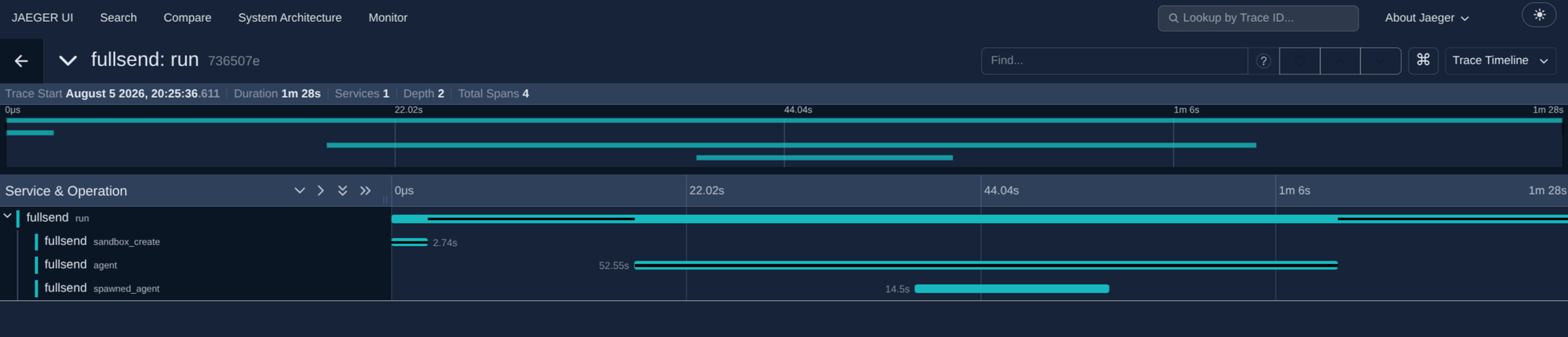
hook_successevent in the parent transcript confirming the PreToolUse hook intercepted theAgent()call.spawned-cost.jsonin the output directory with the spawned process's cost and token usage- Cost: ~$0.30 per run, ~90 seconds (parent $0.24 + spawned $0.06, spawned cost emitted as a separate OTEL span via post_script)
Jaeger trace
All 4 spans under the same trace ID — the spawned_agent span (emitted by the post_script) carries the isolated process's cost and token usage:
Conclusion
The PreToolUse echo-through pattern successfully isolates subagent work into separate claude CLI processes within the same sandbox. This is viable as a short-term mechanism for fullsend to support judge/evaluator agents that need process isolation, until native multi-process support lands via fullsend#3978.
The main trade-off is the extra echo-through subagent (session 3): each intercepted Agent() call pays for one additional cheap inference turn to shuttle the result back to the parent. This overhead is small in practice but could be eliminated if Claude Code added PostToolUse support for the Agent tool or a reliable tool-result injection mechanism.
File Layout
0025-subagent-process-isolation/
├── .fullsend/
│   ├── agents/
│   │   └── judge-parent.md      # Agent definition
│   ├── config.yaml              # Registers the agent
│   ├── config/
│   │   └── claude-hooks.json    # Hook config (injected via host_files)
│   ├── env/
│   │   └── gcp-vertex.env       # Vertex AI credentials (expanded into sandbox)
│   ├── harness/
│   │   └── judge-parent.yaml    # Harness definition (policy fetched from agents repo)
│   ├── hooks/
│   │   └── pretooluse.py        # The PreToolUse hook script
│   └── scripts/
│       ├── post-emit-cost.py    # Post-script: emits OTEL span for spawned cost
│       └── validate-output.sh   # Output validation
├── .gitignore                   # Excludes results/ and .fullsend-cache/
├── HOW_TO.md
└── README.md
Troubleshooting
| Symptom | Cause | Fix |
|---|---|---|
Not logged in · Please run /login | Missing CLAUDE_CODE_USE_VERTEX=1 or export keyword in env file | Ensure gcp-vertex.env uses export for all vars |
Could not refresh access token: policy_denied | Network policy blocks OAuth token refresh | Use protocol: rest and access: read-write in policy; include *.googleapis.com |
harness file not found | Missing config.yaml agent registration | Add agents: [{source: harness/judge-parent.yaml}] to .fullsend/config.yaml |
role field is required | Harness missing role: field | Add role: experiment to harness YAML |
unknown protocol 'tcp' | Old OpenShell policy format | Use protocol: rest instead of protocol: tcp |
| Hook doesn't fire | settings.local.json skipped in sandbox | --dangerously-skip-permissions ignores .local settings; use settings.json injected via host_files to /sandbox/claude-config/settings.json |
| Validation fails / no output files | Agent writes to wrong path | Agent must use $FULLSEND_OUTPUT_DIR (set to /sandbox/workspace/output) |